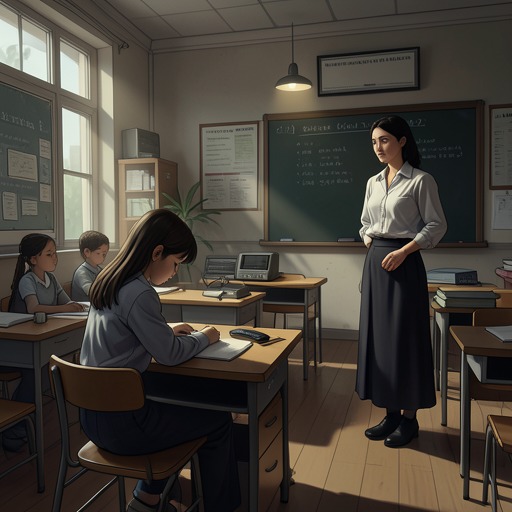
Yasmin Novak
Hold TightYasmin Novak is Jill Baye’s friend and confidante, a girl whose life contracts after a teacher’s public remark turns a personal insecurity into a target for her classmates. Her story traces the consequences of humiliation without reducing her to victimhood: she withdraws from activities, harbors violent fantasies, and eventually acts with Jill’s help during a life-threatening crisis. The friendship gives her a lasting connection even as her confidence and behavior change.
Family and Early Friendship
Yasmin’s parents are divorced, and her father, Guy Novak, is her primary caretaker. Guy remembers that she had adjusted to the divorce and had once been happy, outgoing, and popular. Her mother is largely absent from daily life, seeing her only a few times a year, though she continues to send gifts. Yasmin describes the arrangement as competitive spoiling: both parents try to compensate with presents. Her bedroom reflects that abundance, with stuffed animals covering the beds and floor, including at least two dozen Build-A-Bears and several Webkinz hippos. The crowded room and the brand-new iMac locate her within the material comforts of childhood, but they do not protect her from the isolation taking hold elsewhere.
Jill remains close to her. When Mike Baye sees the girls together, Jill moves easily between him and Mo, while Yasmin stands behind her, nearly cowering, her hair falling across her face and her greeting barely audible. The contrast captures both Yasmin’s growing shyness and Jill’s active effort to keep her included. Jill continues going to dance even after Yasmin quits; she does not treat her friend’s withdrawal as a reason to abandon her.
Humiliation and Withdrawal
The change begins with an incident in class involving Joe Lewiston, Yasmin’s teacher. After Yasmin is described as inattentive and disruptive, Lewiston comments on her slight facial hair while discussing chromosomes. He apologizes the next day and asks the students to stop, but the public embarrassment has already spread through the room. Classmates call her XY, using the male chromosome as a taunt, and the Bearded Lady. Her father confronts Lewiston and shouts at the principal, but neither the apology nor the adult intervention can make the humiliation disappear.
Yasmin quits dance and, in Mike’s recollection, stops nearly all activity. Later, her mother visits from somewhere in the South, possibly Florida, and takes her to a doctor for electrolysis. The treatment removes the facial hair that drew attention, but it does not improve school life. The distinction matters: the visible feature can be addressed, while the social injury and the classmates’ cruelty persist. Yasmin’s retreat is not presented as a simple response to appearance; it follows the public spectacle and the failure of the school environment to undo it.
Anger and Dangerous Secrets
During a sleepover, Jill sees how much Yasmin has withdrawn into efforts to fit in. Yasmin’s bedroom is decorated with posters of teen celebrities, and its stuffed animals, magazines, and pop-star accessories seem to Jill like an anxious performance of girlhood. Yet Yasmin is also observant and capable: she is good with computers, and while the girls are together she notices Beth smoking outside and points it out to Jill.
A more serious discovery comes when Yasmin reaches into stored belongings and finds a loaded gun. She tells Jill that she has fantasized about using it against Joe Lewiston. She describes imagining different ways of confronting him, including a public attack, but also recognizes that this would make her resemble the kind of school attacker she does not identify with. The fantasies reveal how far her anger has traveled; they do not establish that she acts on them. Jill carefully sets the weapon down, and Yasmin asks her to keep the discovery secret. Their exchange makes the friendship a place where Yasmin can disclose what she has not told adults, while also leaving Jill with knowledge of a serious risk.
Later, the girls encounter an online page mocking Yasmin under the title Male or Female?—The Story of XY. Its monkey imagery, primate videos, and school photograph altered with a drawn beard turn the old classroom humiliation into a deliberate online spectacle. Yasmin cries as she shows Jill the page, then says that someone has to pay. Jill remembers that Yasmin once loved piano, dance, and laughter; now she sees a rage that frightens her. The page does not merely repeat the earlier insult. It demonstrates that the bullying has acquired another platform and that Yasmin’s distress has hardened into a desire for retaliation.
Crisis, Friendship, and Significance
Yasmin’s family history becomes part of a murder investigation when an investigator asks Guy to speak with her after telling him that his ex-wife may have been murdered. The request places Yasmin, already in distress, within a larger crisis surrounding her family. The evidence here does not establish what she tells the investigator, but the scene underscores how the private effects of bullying and family disruption intersect with events beyond her control.
In a later hostage crisis, Yasmin and Jill are threatened together. Yasmin catches Jill’s attention with a slight movement of her head, using the familiar classroom signal by which she would send Jill a message when a teacher was looking. Jill initially does not understand, but follows Yasmin’s gaze to her hand. When the girls have an opportunity, Yasmin screams and Jill runs. Their escape depends on communication built through friendship: a gesture learned in ordinary school life becomes a signal in immediate danger.
Yasmin’s arc is defined by the distance between being watched and being understood. Classmates turn a physical trait into a public label; an online page repeats that cruelty; adults apologize or intervene, but cannot quickly restore the life she had before. Jill, by contrast, remains attentive to her and recognizes both the gentleness Yasmin once displayed and the anger now visible in her. Yasmin’s disclosures reveal the risks of her despair, while her action in the hostage crisis shows that she is not only someone to be protected. She can read a situation, communicate under pressure, and help her friend act. The contrast gives her story its central tension: the harm done to her is real, but it does not erase her capacity for loyalty and agency.